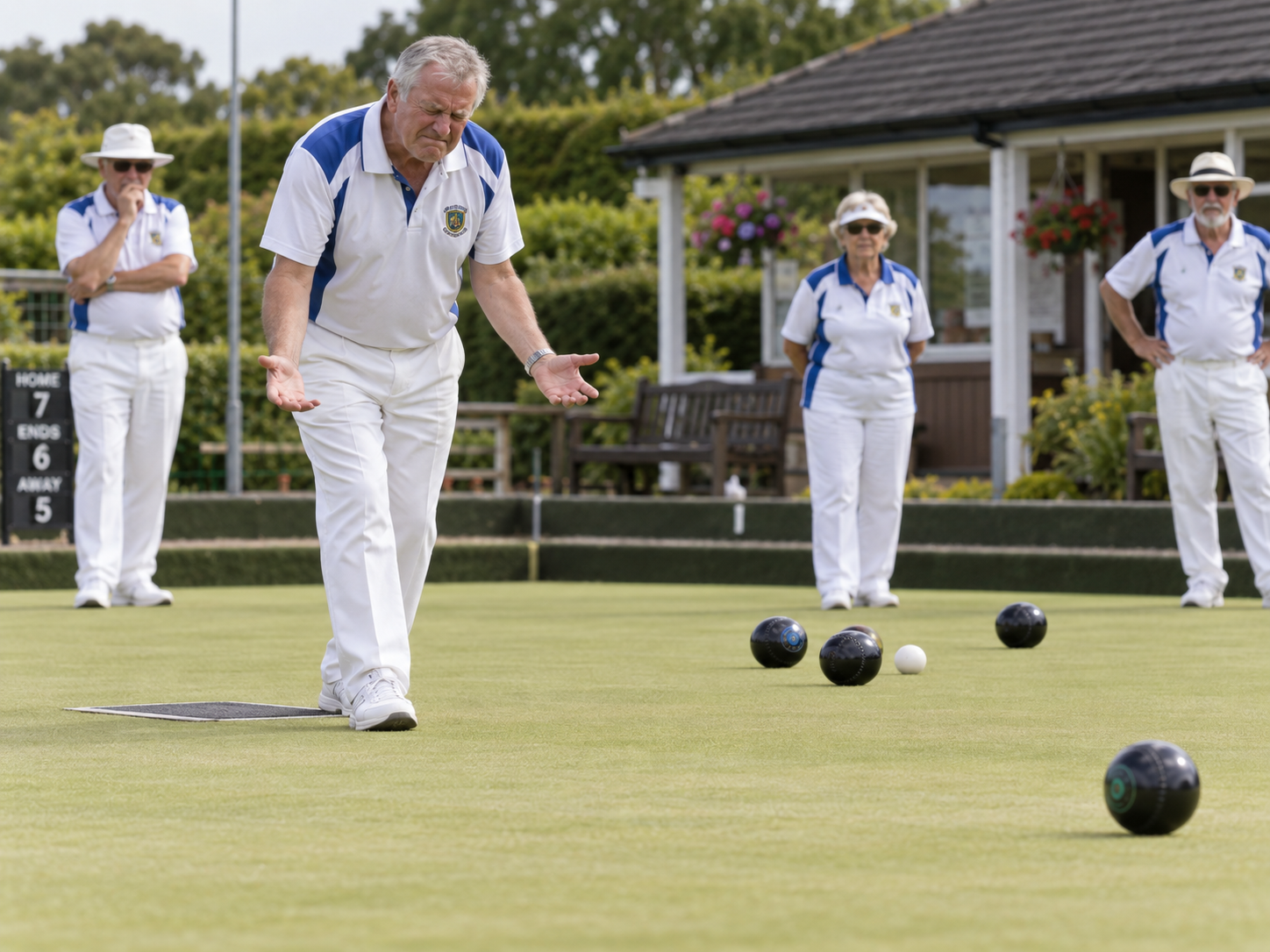

You have just delivered a bowl that did not go where you intended. Perhaps you gave it too much weight and watched it sail past the head. Perhaps it fell short, leaving you wondering whether you had let it go with any conviction at all. You walk back to the mat knowing that you will have another chance.
What happens in your mind before you deliver that next bowl?
If you play lawn bowls regularly, you will recognise how quickly one disappointing delivery can become a discussion with yourself. You replay the movement of your arm. You question your stance. You wonder whether you released the bowl too early or too late. By the time you step onto the mat again, you have several possible faults to correct and only one bowl in your hand.
That is a difficult way to bowl.
There is a time to work on your delivery. You can examine your technique during practice, ask someone to observe you, and repeat a particular movement until it becomes more dependable. A match, including a friendly social game, asks something different of you. Your task is to make the best decision you can about the bowl in front of you and deliver it with care.
The previous bowl may give you useful information. It does not need to become an instruction to repair everything that might be wrong with your technique.
What the last bowl can tell you
Suppose your first bowl finishes two metres short of the jack. You have learnt something about the weight you applied. Before your next delivery, you can consider the distance again and decide that the bowl needs a little more energy.
That is a useful adjustment. You have observed a result, decided and returned your attention to the next delivery.
Now imagine a different response. You decide that the short bowl proves you have developed a problem with your backswing. You try to take your arm further back, lengthen your stride, change the speed of your movement and release the bowl more firmly. As you deliver it, you are monitoring each of those actions. You are also hoping, rather anxiously, that nobody notices how much thought has gone into a bowl that may still finish short.
The result may be better or worse, but your attention has been pulled in several directions. You are no longer simply delivering the bowl you have chosen. You are trying to diagnose and fix your bowling while you play.
There is a difference between using the last bowl as information and treating it as a verdict on your ability. One helps you decide. The other can leave you preoccupied with yourself.
The bowl in your hand has its own job
Every bowl you deliver has a purpose. You might be drawing towards the jack, adding a bowl behind the head, protecting a position or trying to move an opponent’s bowl. The line and weight you choose should serve that purpose.
That sounds straightforward until a previous mistake starts influencing your decision.
After bowling too long, you may become determined not to repeat it. You then deliver cautiously and leave the next bowl well short. After missing narrow, you may aim so wide that the bowl never threatens the head. In both cases, your decision is shaped mainly by what you are trying to avoid.
A more helpful question is: What does this bowl need to do?
Look at the head. Take account of the conditions and the bowls already there. Choose where you want yours to finish. Decide on a line and a weight that give it a reasonable chance of getting there. Once you have made that choice, give the delivery your attention.
You cannot guarantee the result. The green may be doing something you have not quite worked out, and the bowl may travel differently from the way you expected. But you can give this bowl a clear intention. That is within your control.
When technique takes over your thoughts
Many bowlers have experienced a period when a delivery feels less reliable than usual. You might become aware of your grip, the position of your feet or the movement of your arm. The temptation is to sort it out immediately, especially when the score matters.
The difficulty is that a delivery does not usually improve when you try to control every part of it at once. You may end up on the mat with a running commentary in your head: keep your shoulder still, watch your step, do not rush, release smoothly, follow through. Somewhere in the middle of all that, you still must send a bowl towards a target.
If you have identified a specific issue that you already know how to address, one simple reminder may help. But a match is rarely the best setting for a full investigation of your technique. You can make a note of the concern and spend proper time on it in practice. For now, bring your attention back to the delivery you are about to make.
You can ask yourself where the bowl needs to finish and how much weight you intend to give it. Then let yourself deliver it.
This does not mean pretending that technical problems do not exist. It means giving them the attention they deserve at a time when you can work on them properly, rather than asking one bowl in the middle of a match to prove that you have solved them.
Notice how the past follows you onto the mat
Bowling in the past often begins with perfectly understandable thoughts. You remember a bowl that cost your team a shot. You hear a teammate offer a suggestion and start wondering whether everyone has noticed the same problem. You recall missing a similar draw last week. None of these thoughts is unusual.
The question is whether you continue to engage with them when you are preparing to bowl.
Picture an ordinary end. Your team needs a bowl close to the jack. Your previous attempt missed the line. You step onto the mat thinking, “I must not do that again.” Your attention is now on the missed line, even though you need to choose and commit to a line for this delivery.
You may find it useful to pause before you step onto the mat. Look at the head and decide what you are attempting. If a thought about the last bowl appears, acknowledge it briefly. Then return to what you can see and what you intend to do. You do not need to win an argument with the thought before you bowl.
That is what bowling in the present looks like in practice. You make use of what you have learnt, but you give your attention to the bowl you can still deliver.
Intention should be specific
“Bowl a good one” is an understandable hope, but it gives you little to work with. So does “Don’t mess this up.” A useful intention is more specific.
You might decide to draw to the forehand and finish just behind the jack. You might aim to pass through a gap with enough weight to reach a particular bowl. You might choose a safe position that limits what your opponent can do next. Your intention depends on the head, your role in the team and your judgement of the conditions.
Once you have chosen, you can picture the path you want the bowl to take and the area where you want it to finish. You can feel the weight you mean to apply. Then you deliver.
That connection between your decision and your movement matters. When you are occupied with correcting the last bowl, you can lose track of the bowl you meant to play. When your attention is on the line, weight and intended finish, your actions have a clear direction.
Thoughtful bowling does not require you to stand on the mat for ages. Your teammates may appreciate a clear decision almost as much as they appreciate a well-delivered bowl. Take the time you need to understand the shot, then commit to it.
Give yourself a practical way back
You will still have moments when frustration gets hold of you. Everyone does. A bowl that finishes nowhere near its intended destination can be irritating, especially when you felt confident as it left your hand. Lawn bowls also gives you ample time to watch that irritation travel down the green.
When it happens, let the bowl finish. Notice the result. If there is useful information in it, take that information. Then prepare for the next decision.
You could use a short question to bring yourself back: Where does this bowl need to finish? It directs your attention towards the current task. You might also take a comfortable breath while you look at the head, giving yourself a moment to settle before choosing your line and weight.
There is no need to turn this into an elaborate routine. The point is to interrupt the habit of replaying a mistake and give yourself room to make a fresh decision.
Your next bowl may still miss. Being present is no guarantee of perfect bowling. It does, however, give that bowl your best available attention. You have a much better chance of delivering thoughtfully when your mind is concerned with the shot you have chosen than when it is busy conducting an enquiry into the one you have already played.
Learn during the game, practise after it
You can take your bowling seriously without making every match a technical lesson. During play, observe what is happening. Adjust your decisions as you learn about the green, the conditions and your own weight. If the same delivery problem keeps appearing, remember it for later.
Afterwards, you can investigate it properly. Was the problem consistent? Did it happen on both hands? Did it appear only when you tried to play with more weight? Those questions are easier to answer when you can practise without the immediate demands of a changing head and a waiting opponent.
This approach allows you to keep learning while you compete. It also gives practice a clear purpose. Instead of leaving a match with the vague feeling that “everything was wrong”, you can identify one thing worth working on.
The same applies when you bowl socially. A relaxed game is still more enjoyable when you allow yourself to play the bowl in front of you. If you spend the afternoon analysing every delivery, you may reach the end +
mentally exhausted, even though the most strenuous part of the day appeared to be walking between the mat and the head.
Deliver this bowl
Lawn bowls gives you repeated chances to begin again. Each delivery is influenced by what you have learnt, but it does not have to be controlled by what went wrong before it.
So, when a bowl disappoints you, give it an honest look. Take the information you need. If there is a technique issue to address, make time to work on it. Then turn your attention to the next bowl.
Look at where you want it to finish. Choose the line and weight that serve that intention. Step onto the mat and deliver with your mind on the bowl you are playing now.
The last bowl is already down the green. This one is still in your hand.